 中国地区询价
 1 (250) 388-3531
 +33 4 86 68 68 10

ISO 17025 Interlaboratory Studies (ILS) Report Published
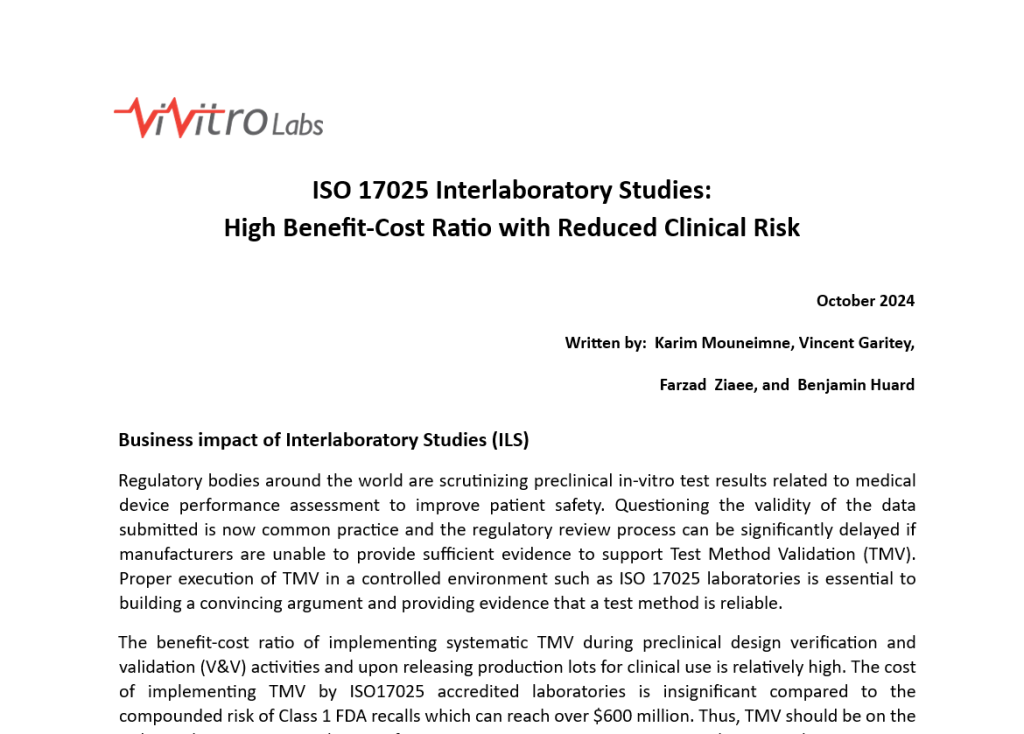
VICTORIA, BC, October 08, 2024 — ViVitro Labs announces the publication of a new paper, ISO 17025 Interlaboratory Studies: High Benefit-Cost Ratio with Reduced Clinical Risk, documenting a recently concluded ISO 17025 Interlaboratory Study (ILS) that highlights the complexity of Test Method Validation (TMV) and the importance of conducting an ILS. The ILS uses an actual Acute Particulate Matter Evaluation study as an example.
Written by: Karim Mouneimne, Vincent Garitey, Farzad Ziaee, and Benjamin Huard, the paper underscores the High Benefit-Cost Ratio business impact and risk mitigation benefits of ILS. The authors suggest a similar process be used and integrated into a Quality Management System (QMS) to benefit other tests including Heart Valve Hydrodynamic Performance Testing and Accelerated Wear Testing.
Proper execution of TMV in a controlled environment such as ISO 17025 laboratories is essential to building a convincing argument and providing evidence that a test method is reliable. The benefit-cost ratio of implementing systematic TMV during preclinical design verification and validation (V&V) activities and upon releasing production lots for clinical use is relatively high.
Robust single-laboratory studies can provide sufficient evidence, but undetected biases could
jeopardize TMV. Inadequate measurement uncertainty budget and calculations can create false
positive results. Setting a process to constantly monitor the validity of results generated through single laboratory studies is an absolute minimum to improve TMV and minimize the risks associated with false positive results.
Whenever possible ISO 17025 Interlaboratory Studies (ILS) should be implemented to reinforce the uncertainty budget and further reduce risks. ILS should be performed for critical performance tests that are frequently conducted on finished devices.
About ViVitro Labs
Trusted partner for scalable and modular test equipment and testing solutions through continuous innovation and regulatory expertise that de-risks the cardiovascular device development process through repeatable and reproducible validated test methods. Hundreds of organizations in over 40 countries for 40+ years have trusted ViVitro expertise, reliability, and quality in testing heart valves, LVAD, interventional devices, stent, and stent-graft.
ViVitro Laboratory Services have two ISO/IEC 17025 accredited laboratories (see our ISO 17925 scope of accreditation for Marseille, France and Victoria, Canada). ViVitro Labs products are manufactured by StarFish Medical in Victoria, Canada. https://vivitrolabs.com/