 中国地区询价
 1 (250) 388-3531
 +33 4 86 68 68 10

Guidewire Testing Services
Guidewires facilitate catheter placement and exchange by navigating through vessels to the therapy location. Guidewires can be intended for use in the coronary vasculature, peripheral, vasculature, and neurovasculature A number of methods are used to ensure these devices demonstrate safety, efficacy, and quality, while performing according to their intended use and labeling. We offer comprehensive guidewire testing services in accordance with ISO standards, ASTM Standards, FDA guidance documents, and the latest peer reviewed research.

Courtesy of Abbott – GuideRight™ guide wire
Acute Particulate Matter Evaluation
An in-line continuous particulate counting system is used to assess the number and sizes of particles generated during simulated use in real-time inside an anatomical model.
Learn moreCatheter Compatibility Testing
Accessories are used with the catheter. For examples guidewires, guiding catheters, and introducer sheaths are used with the catheter to show compatibility of lumens.
Learn moreCoating Integrity Optical Inspection
A Scanning Electron Microscope (SEM) and/or an optical microscope with proper magnification is used to inspect the surface defects and coating integrity of the device before and after testing. Coating anomalies, defects or artefacts are located and documented.
Learn moreCorrosion - Immersion Test
The catheter is immersed in a physiological saline solution for 5 hours then in boiling distilled or dionized water for 30 min. Samples are kept at 37°C for 48 hours before cooling down to room temperature. Test samples are visually inspected for traces of corrosion with an optical microscope in comparison to reference samples.
Learn moreCrossability
Uses the proximal load cell to measure the ability of the device to advance and withdraw, with no loss of function or damage to the tortuous anatomy, over a specific lesion site. The roller system and the camera allow determining the worst-case lesion that the stent can withstand without damage.
Learn more
Determination of longitudinal tensile strength (endovascular device)
Test samples coupons or the entire length of a catheter are chosen so that each tubular portion, each junction between hub or connector and tubing, and each junction between tubular portions is tested. A tensile force is applied to each test piece until the tubing breaks or the junction separates.
Learn moreDimensional Attributes
A contactless optical gauging machine is used to measure dimensional attributes of the device.
Learn more
Flexibility / Kink Resistance
Medical device may be subjected to tight angulations in tortuous vasculature during use. Inability to withstand flexural forces that are typical of clinical use could lead to device failure or vessel damage. The ability of a delivery system or a catheter to bend in order to accommodate the predetermined clinically relevant radius or angles is critical during vascular access. The ability of a stent like structure to bend without lumen narrowing plays a critical role in maintaining stent patency
Learn more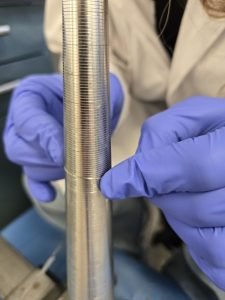
Fracture of Guidewires
The guidewire is wrapped around a predefined cylindrical fixture. Once removed the guidewire is examined for visible signs of fracture
Learn more
Hydrophilic Coating Friction Test - Lubricity/Pinch Test
The purpose of this test is to assess the lubricity and the durability of hydrophilic coatings (on balloons, catheters etc). The most common test used for finding friction at a surface is a pinch test, where test samples are pinched between two plates (pads) with a known amount of force or a defined distance, while using a motor to pull and/or push the test article through the plates. The force it takes to pull and/or push the device through can be measured. Passing the device through the pinch test multiple times will eventually cause the coating to fail and friction readings to increase.
Learn more
Peak Tensile Force / Tensile Bond Strength
Tensile test (uniaxial) to determine the bond strength at locations where adhesives, thermal fusion, or other joining methods are used for bonding components of the delivery system.
Learn morePushability
Pushability uses the proximal and distal load cell to measure the amount of force the distal tip of the guidewire sees when a known force is being applied to the product on the proximal end.
Learn more
Resistance to damage by flexing
A guidewire can be subjected to flexing or bending during clinical use. The guidewire shall not be damaged and device characteristics shouldn’t be changed to guarantee the intervention success.
Learn more
Rotational Response
A customer-defined number of revolutions is applied to the proximal end of a device with a customer defined step. At each step, the corresponding rotation at the distal end is measured by direct reading on the distal measurement system and then recorded. The tests can be performed in straight path or in a predefined arterial model.
Learn more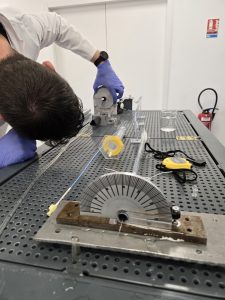
Simulated Use Pre-conditioning
Before conducting other evaluations, test samples should undergo all the steps a finished device would go through before being implanted in the patient.
Learn more
Simulated Use Testing
Uses the roller system and the camera to qualitatively evaluate the performance of the device using a tortuous path that simulates the intended use conditions.
Learn more
Simulated Use Testing with Backout Support
A catheter is deployed over a guidewire. The catheter is removed and guidewire must be left in place. Special case of Simulated use testing.
Learn more
Three-Point Bending
The rigidity of catheter, stent, or endovascular device is measured using a three point deflection method. The sample rests perpendicular to two lower static supports, with an applied deflection site centered between them. A displacement is applied at a fixed rate while measuring the resultant force. The test stops when the displacement reaches 0.2 x span length.
Learn moreTip Flexibility / Tip Stiffness
Determine the flexibility of the guidewire tip by measuring the buckling deformation force.
Learn more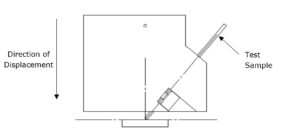
Torque Strength
Intravascular/endovascular devices may be subjected to torsional forces during use. Inability to withstand torsional forces that are typical of clinical use could lead to device failure or vessel damage.
Learn moreTorqueability
Measure of the amount of torque transmitted through the guidewire. Also known as Torque Response.
Learn moreTorsional Bond Strength
The purpose of this test is to determine the torque required to cause failure of the joints and/or fixed connections in the catheter system.
Learn moreTrackability
Trackability uses the proximal load cell to measure the force to advance the device through a tortuous anatomy with or without the aid of a guiding accessory such as a guidewire, guide catheter, etc.
Learn more
Withdrawbility
Withdrawbility involves retracting or re-sheathing the medical device as part of simulated use testing to determine the ability to withdraw.
Learn more
ISO 11070:2014 Sterile single-use intravascular introducers, dilators and guidewires.
ViVitro Labs provides guidewire testing services such as guidance on size designation, safety wires, fracture, flexing, peak tensile force, and corrosion.
FDA Guidance (document number 16007, Docket Number:FDA-2018-D-1775) Coronary, Peripheral, and Neurovascular Guidewires – Performance Tests and Recommended Labeling.
ViVitro Labs provides guidewire testing services such as predicate comparison and non-clinical bench testing including pre-conditioning, simulated use (and simulated use models), dimensional verification, tensile strength, tip pull, torque strength, torquability, coating integrity, particulate evaluation, lubricity, corrosion resistance, kink resistance, tip flexibility, and radiopacity.
Other standards such as ISO 25539-2:2020 give guidance on catheter compatibility and ViVitro Labs is a leader in providing customized test methods for cutting edge or novel guidewire designs.
While guidewires may seem simplistic to the untrained eye, in reality they are highly complex composite devices which contain multiple interacting elements. There may be a core wire which provides stiffness to the system. The coil of a guidewire is helically wound wire (typically around the core). The guidewire may contain a safety wire which is an additional wire to minimize the possibility of tip detachment. The guidewire may have a formed and shaped tip to allow for easier navigation through tortuous anatomy. Guidewires may have a hydrophilic coating to improve lubricity. There continues to be many technological advancements in this space and ViVitro is an industry leader in developing guidewire testing services for these novel devices.