 中国地区询价
 1 (250) 388-3531
 +33 4 86 68 68 10

Heart Valve Device Testing
Heart Valve Replacement and Repair Devices
Native heart valves with abnormal stenosis or regurgitation may be repaired or replaced surgically or interventionally in order to resume proper function. A number of test methods are used to ensure prosthetic heart valves demonstrate safety, efficacy, and quality, while performing according to their intended use and labeling. ViVitro Labs offers a large array of testing services to assess the performance of heart valve replacement and repair devices in accordance with ISO standards, ASTM Standards and FDA guidance documents.
ViVitro Labs is a leader in providing standardized as well as customized test methods for cutting edge and novel aortic, mitral, pulmonary and tricuspid heart valve replacement or repair devices.
For catheter based delivery systems see additional tests here.

Courtesy of Abbott – Portico™ valve
Accelerated Wear Testing (AWT)
Stress artifacts caused by high frequencies testing of heart valve prosthesis have been reported in various versions of ISO 5840 and discussed in standardization committees for years. It is known that Accelerated Wear Testing (AWT) imposes unrealistically severe conditions not seen in normal physiologic conditions. It is common knowledge that the inertial forces on heart valve prosthesis increase significantly when exposed to accelerated wear testing conditions. To avoid unwanted in-vitro test artifacts resulting in premature failure of perfectly sound heart valve prosthesis designs, ViVitro’s AWT System with Dual Control Technology (DCT)™ maintains constant leaflet closing velocities across the entire AWT cycling period. With its proprietary and patented Dual Control Technology (DCT)™, the ViVitro’s AWT System uses two separate position feedback sensors and algorithms to control piston displacement and bypass valve independently to meet differential pressure requirements while preserving initial leaflet closing velocities, and optimizing passing cycles.
Learn more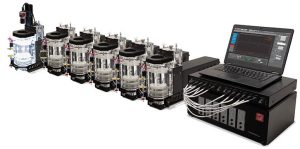
Dimensional Attributes
A contactless optical gauging machine is used to measure dimensional attributes of the device.
Learn more
Durability Testing (Integrated Durability Assessment)
Durability testing is intended to determine the in-vitro lifetime, the anticipated failure modes, and potential failure consequences (e.g. immediate total loss of function or gradual degradation of function).
Learn more
Dynamic Failure Mode (DFM)
Dynamic Failure Mode (DFM) testing of heart valve prosthesis is used together with Accelerated Wear Testing (AWT) to provide a thorough assessment of durability. Since AWT is a “test to success” approach meaning samples are intended to survive the test, DFM testing is a “test to failure” approach which is intended to characterize potential durability-related failure modes.
Learn moreDynamic Migration
A measurement at which pressure of a device begins to migrate under pulsatile flow conditions.
Learn more
Effects of Device Post-Dilatation
An assessment of the effects of post-implant dilatation on the leaflets and frame should be conducted if this is an expected use condition to which the (novel) heart valve substitute will be exposed.
Learn moreEx-Vivo Beating Heart
Our ex-vivo beating heart simulator is used to test transcatheter devices when realistic anatomy is required.
Learn moreExperimental Flow Field Assessment – Digital Particle Image Velocimetry (DPIV)
The thrombogenic and haemolytic potential of the heart valve substitute can be assessed using a combination characterization techniques: digital particle image velocimetry (DPIV), computational fluid dynamics (CFD), and ex-vivo methods (e.g. blood loops).
Learn moreExperimental Flow Field Assessment – Echo Doppler - Bernoulli’s Equation Verification
The goal of the test is to determine, in vitro, for a specific artificial cardiac valve the value of the coefficient K in the Bernoulli equation, ΔP = K (Vd2 – Vp2).
Learn morePulsatile Flow Testing - Hydrodynamic Performance
Hydrodynamic Performance Pulsatile Flow Testing – Forward flow and regurgitant performance of the device will be assessed under physiological pulsatile flow conditions. Key indicators of valve performance such as Effective Orifice Area (EOA) and regurgitant fraction (RF) are determined.
Learn moreReal-Time Wear Testing (RWT)
Real-time wear testing (RWT) is intended to match physiological loading conditions as closely as possible as to what would be obtained in a real patient. Due to the viscoelastic nature of some materials, Accelerated Wear Testing may actually under test devices, so RWT can be used to identify frequency dependent failure modes.
Learn moreScanning Electron Microscopy (SEM) and Optical Inspection

Sewing Ring Integrity
A measure of the resistance to sewing ring dehiscence. Failure may result from sutures, suture retention failure, fabric tensile strength failure, fabric weave failure, or fabric seam failure.
Learn moreSimulated Use Pre-conditioning
Before conducting other evaluations, test samples should undergo all the steps a finished device would go through before being implanted in the patient.
Learn more
Simulated Use Testing Under Pulsatile Flow
Devices can be subjected to various physiological pulsatile flows and pressures.
Learn moreSteady Flow Testing - Hydrodynamic Performance
Hydrodynamic Performance Steady flow testing determines the forward and reverse flow performance characteristics of a valve in a simple and highly controlled manner. While no formal acceptance criteria exists for steady flow testing, it can be useful in confirming results of pulsatile flow testing.
Learn more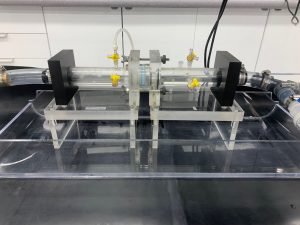
Steady Flow Testing - Stent Post Deflection
The deflection of the stent lateral struts (post) is measured when subjected to different back-pressures.
Learn moreISO 5840-1:2021 Cardiovascular implants — Cardiac valve prostheses — Part 1: General requirements
ViVitro Labs provides heart valve testing services such as hydrodynamic performance assessment (steady flow testing, steady), structural performance assessment, implant durability assessment (accelerated wear testing (AWT), dynamic failure mode testing (DFM), and real-time wear testing (RWT)), component corrosion assessment (pitting corrosion, crevice corrosion, galvanic corrosion, corrosion fatigue, fretting (wear) and fretting corrosion) , human factors/usability assessment, and implant thrombogenic and haemolytic potential assessment (digital particle image velocimetry (DPIV)
ISO 5840-2:2021 Cardiovascular implants — Cardiac valve prostheses — Part 2: Surgically implanted heart valve substitutes
ViVitro Labs provides surgical heart valve testing services such as hydrodynamic performance assessment (pulsatile flow), cavitation, visibility (radiopacity), sewing ring integrity, stent creep, static pressure burst test, calcification, particulate generation, effects of device post-dilatation, leaflet impingement force, leaflet escape force, sewing ring push-off, sewing ring torque, device migration resistance
ISO 5840-3:2021 Cardiovascular implants — Cardiac valve prostheses — Part 3: Heart valve substitutes implanted by transcatheter techniques
ViVitro Labs provides transcatheter heart valve testing services such as: hydrodynamic performance assessment (pulsatile flow), Device migration resistance, Implant foreshortening, Crush resistance, Recoil, Radial resistive force (RRF), Chronic outward force, Visibility (radiopacity), Simulated use, Stent creep, Static pressure; “burst” test, Calcification, Particulate generation, Effects of device post-dilatation, Expansion uniformity, Bailout option evaluation, Intentional cracking of a pre-existing prosthesis, Valve in Valve (ViV), Valve in Ring (ViR)
For catheter based delivery systems see additional tests here.
ISO 5910:2018 Cardiovascular implants and extracorporeal systems — Cardiac valve repair devices
ViVitro Labs provides transcatheter heart valve repair device testing services such as: functional performance assessment (steady back-flow leakage testing, Pulsatile-flow testing), device structural performance assessment, device durability assessment (accelerated wear testing (AWT), dynamic failure mode testing (DFM), and real-time wear testing (RWT)), device corrosion assessment, visibility (radiopacity), simulated use assessment, human factors / usability assessment
For catheter based delivery systems see additional tests here.
Devices Tested include:
Surgical and Transcatheter Aortic Valve Implantation (TAVI) [also known as transcatheter aortic valve replacement (TAVR)]
Surgical and Transcatheter Mitral Valve Implantation (TMVI) [also known as transcatheter mitral valve replacement (TMVR)]
Surgical and Transcatheter Pulmonary Valve Implantation (TPVI) [also known as transcatheter pulmonary valve replacement (TPVR)]
Surgical and Transcatheter Tricuspid Valve Implantation (TTVI) [also known as transcatheter tricuspid valve replacement (TPVR)]
Surgical and Transcatheter valvular repair devices including: (edge to edge, direct annuloplasty, indirect annuloplasty, annular plication, chordal replacement, coaptation enhancement, ventricular remodeling, and other novel techniques)
Soft polymeric heart valve prosthesis, rigid polymeric heart valve prosthesis, biological heart valve prosthesis, mechanical heart valve prosthesis